Glycemic Index vs Glycemic Load: Research Context
Understanding how carbohydrate-containing foods affect blood glucose: measurement approaches, research applications, and practical interpretation.
Introduction
In the study of carbohydrate nutrition, two related concepts—glycemic index and glycemic load—provide numerical measures of how foods influence blood glucose dynamics. Both tools emerged from nutritional research seeking to quantify carbohydrate quality and predict metabolic responses. This article explains how these measurements are derived, what they measure, and how they are applied in research contexts.
Glycemic Index: Defining the Concept
The glycemic index (GI) is a numerical ranking system that compares how quickly a carbohydrate-containing food raises blood glucose levels relative to a reference food—typically pure glucose, which has a GI of 100.
To measure GI, researchers feed subjects a standardized portion of a test food containing a fixed amount of carbohydrate (usually 50 grams). Blood glucose is measured at regular intervals over 2-3 hours after consumption. The area under the glucose response curve is calculated and compared to the area under the curve from an equivalent portion of reference glucose. The ratio, multiplied by 100, yields the GI value.
GI Classification Categories
Foods are classified based on their GI values:
- Low GI: 55 or below
- Medium GI: 56-69
- High GI: 70 or above
Low-GI foods produce slower, more gradual rises in blood glucose, while high-GI foods produce rapid, pronounced glucose elevation. Factors affecting GI include food structure, ripeness, processing, cooking method, presence of fiber, and food combinations.
Limitations of Glycemic Index
While GI provides useful classification, it has notable limitations. GI measures the rate of glucose rise but not the total amount. For example, watermelon has a high GI (around 72) but typically contains relatively little carbohydrate per serving. Additionally, GI is measured using a standardized serving size (50 grams carbohydrate), which may not reflect typical consumption portions. Individual variation in glucose response—affected by insulin sensitivity, physical fitness, and metabolic state—is also not captured by GI.
Glycemic Load: A Practical Refinement
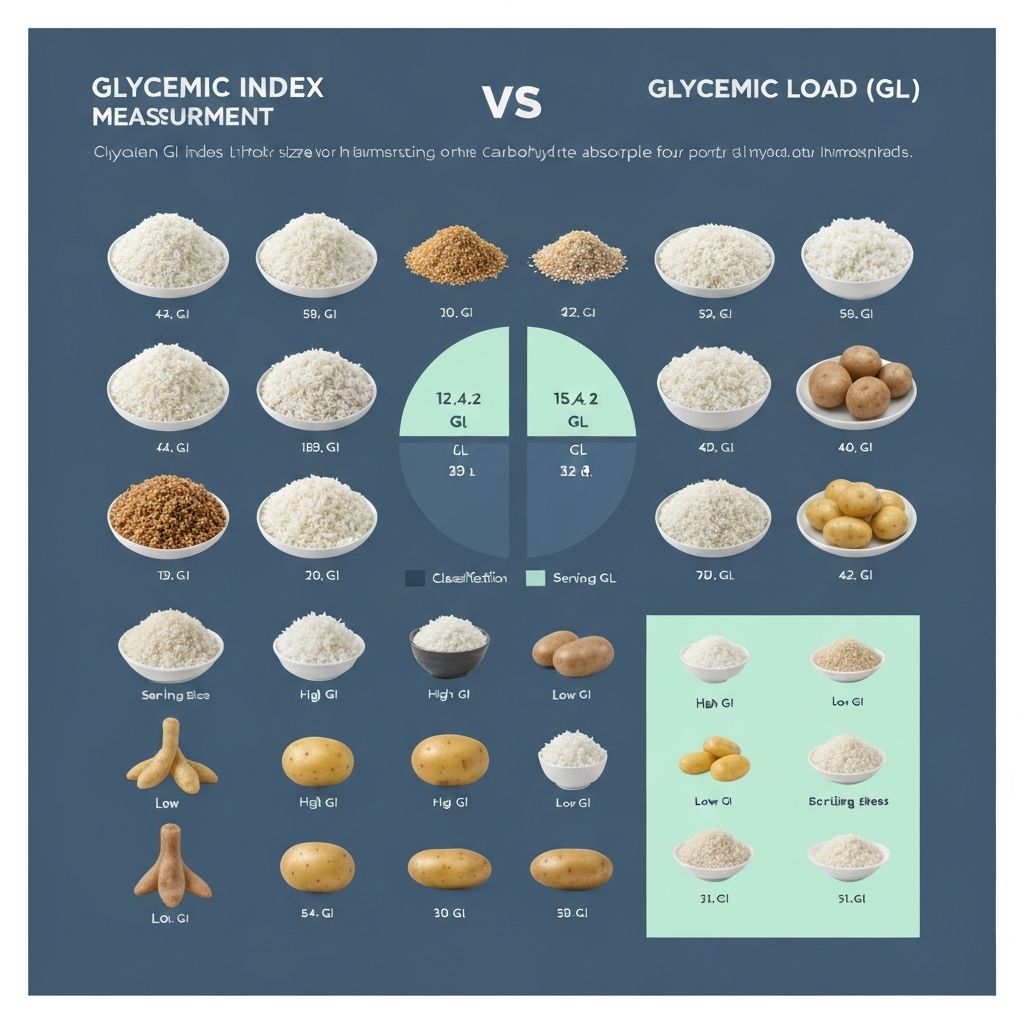
Glycemic load (GL) was developed to address the portion-size limitation of GI. GL accounts for both the carbohydrate quality (reflected in GI) and quantity consumed in a typical serving:
GL = (GI × carbohydrate content in grams per serving) / 100
This allows for more practical comparison of foods as typically consumed. For example:
- Watermelon: GI of 72, but typical serving contains only 12 grams carbohydrate → GL of ~8.6 (low)
- White bread: GI of 75, typical serving contains 15 grams carbohydrate → GL of ~11.3 (medium)
- Lentils: GI of 32, typical serving contains 15 grams carbohydrate → GL of ~4.8 (low)
GL Classification
Glycemic load values per serving are typically classified as:
- Low GL: 10 or below
- Medium GL: 11-19
- High GL: 20 or above
Research Applications
In nutritional science, both GI and GL are used as descriptive tools to understand carbohydrate quality and predict physiological responses. Researchers use these measures to:
- Classify carbohydrate-containing foods systematically
- Predict blood glucose and insulin responses in controlled settings
- Examine associations between carbohydrate quality and metabolic outcomes in observational studies
- Design controlled dietary interventions with defined carbohydrate characteristics
Individual Variation
Important to note: individual responses to foods with the same GI or GL can vary considerably. Factors including physical fitness, prior glucose tolerance, meal composition, physical activity level, and individual metabolic characteristics influence actual glucose responses. GI and GL represent population averages, not individual predictions.
Integration with Overall Carbohydrate Science
GI and GL provide useful context within the broader understanding of carbohydrate metabolism. They describe how different foods affect blood glucose dynamics—information relevant to understanding short-term metabolic responses. However, long-term weight and metabolic outcomes depend primarily on total energy balance, which encompasses total calories consumed and expended, irrespective of macronutrient composition.
Conclusion
Glycemic index and glycemic load are standardized research tools that quantify carbohydrate quality and predict blood glucose responses. Both measures provide useful descriptive information about how different foods influence glucose dynamics in research settings. As descriptive measures, they contribute to scientific understanding of carbohydrate physiology without prescribing dietary choices or predicting long-term weight outcomes.